YouTube announced a more concerted effort to sanction any creator that engages in videos that are potentially harmful to viewers, or advertisers, and through it’s predefined standards, may permanently bar such channels from serving ads on the platform.

While the significant of the changes are not just that it hit hard at creators, but that it also point to a real shift for the platform, which formerly is conceived as a hub for prank-filled videos and potentially offensive content, in the name of freedom of expression.

The company has employed AI to track the content of what’s being posted, and in cases where videos fail it’s advertising guidelines, or pose a threat to its wider community, may result removal of the channel’s eligibility to be recommended, such as appearing on the home page, trending tab or watch next.

Also it will remove monetization options on the videos, and specifically deny them access to its advertising programs.

YouTube has outlined potential penalties it may deem necessary as follows:

  • Content Recommendations: The removal of a channel’s eligibility to be recommended on the platform, including appearing on YouTube home page, trending tab or watch next.
  • Monetization: The suspension of a channel’s ability to serve ads, and potentially removal from the YouTube Partner Program, including creator support and access to YouTube Spaces.
  • Content Development Partnerships: The removal of a channel from YouTube Original creators, and Google Preferred contents.


The changes are coming on the heels of Google's effort to raise the overall quality of what is posted and shared and viewed by millions of people on its various platforms, which was necessitated by the proliferation of "fake news" that marred the last U.S. presidential elections.

Albeit, the majority of creators on YouTube will not be impacted by the changes as many contents are not on the wrong side of the rules.

The penalties will only apply as a last resort and often a temporary bar, though it may last indefinitely, pending if the creator has made amendments or altered the infringing content.

YouTube's clampdown on Channels posting offensive videos


Google has released the beta of Android KTX, as extensions designed to ease coding in Kotlin, while the API layer works on top of Android’s framework and have library support.

Android KTX is perhaps the first time Google is making a library specifically for Kotlin developers, albeit it isn't bringing any new features to the Android APIs. Kotlin was openly endorsed by Google as a preferred language for Android development last year, the KTX beta extensions is meant to improve on the Kotlin development experience.

The KTX package begins with androidx, which is a new prefix used in latest versions of the support library. And the proponents hope it will make it more obvious which APIs are bundled with the platform and which are static libraries for developers working with different versions of Android.

According to the KTX developers, the APIs could change during the course of the beta period, but pledges that when KTX reaches 1.0 production status, maintaining API compatibility will be more thorough.

Some advantages of KTX in simplification of coding is as follows: Useful in SharedPreferences, which provides an interface to modify preference data, as the KTX code is shorter and more natural to read and write.

Also, the Android String class will enable more-natural conversion of strings to URIs through KTX extension, and less code would be required when translating the difference between two paths in an Android program.

The source code for the part of Android KTX that works with the Android framework can be downloaded from this Github repo. And developers who wish to give it a spin, can get started from the binary file from Google’s Maven repository and add the dependency androidxcore:core-ktx:0.1 in the build.gradle file of their Android Kotlin project.

How Android KTX Extensions make coding in Kotlin easier


Facebook Messenger is evolving into an all-in-one messaging platform, and now a new feature is in the works that let users overlay a chosen emoji on their Messenger profile picture for 24 hours as a way to let people know their current status without necessarily requiring an outright post.

While users emoji can be found in the Active tab on Messenger, the new feature could potentially expand "Your Emoji" to show up even within the inbox and message threads.

Matt Navarra, director of Social Media for TheNextWeb shared screenshots about the new feature which is currently been tested: the ability for people to add an emoji to their profile photo in Messenger to let their friends know what they’re up to or how they’re feeling in the moment.

It allows for offline meetup opportunity just like AOL Instant Messenger’s old away messages, and there’s a ton of other potential behavioral tags like "red circle" which could mean don’t interact, or GPS dot-style blue diamond could mean out on the town. While the moon emoji can be used to signal an after party is going down later.

Facebook aim to position the messaging platform as all-in-one hub for meaningful interactions, not just passive media consumption, by opening up better signals to help conversations.

And perhaps, Messenger is the best-poised app to make an offline meetup tool, to spur conversation and hang outs in ways never before thought possible.

Facebook testing new "Your Emoji" status for Messenger


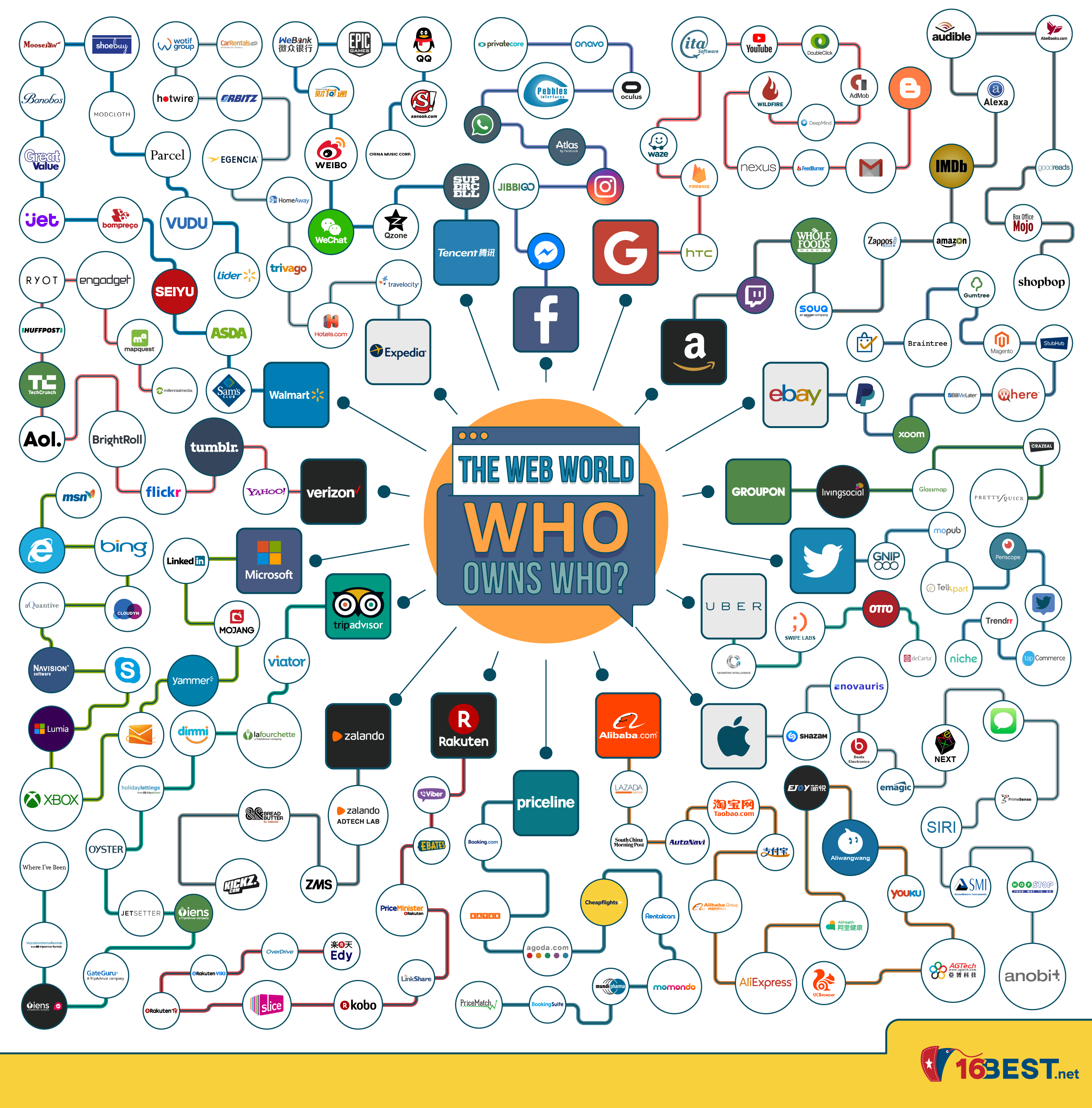
Over the last couple of decades, a merger and acquisition fever has swept through the Internet's largest businesses. It seems that major companies such as Amazon, eBay, Facebook and Microsoft, to name a few, are all addicted to buying the rights, assets and control of other smaller (but by no means small) companies.

The truth is, most of the Internet's most popular websites and services are owned by only a handful of companies we are familiar with. Did you know, for example, that when you buy a pair of Beats headphones, some of your money gets funneled back to Apple? It is true, and it may surprise you to learn just who owns some of the Internet's most popular websites.

Here is our list of four major internet companies that dominate the market and are addicted to acquiring other companies.
  • Google 
Google is obviously the most widely-known name on the entire internet; you probably found this article because of a Google search. Although Google began as just a search engine, it has grown into one of the world’s largest companies that has, over time, taken over other large companies and brands.

For example, Google owns YouTube which it acquired in 2006, Blogger.com and operates smartphone brands such as Pixel and Nexus phone brands.

  •  Expedia
Although you may be surprised to learn that Expedia, the travel website, plays a big role in mergers and acquisitions, it’s true; it is the core of their growth strategy. Expedia have historically bought a large number of other travel-related companies.

Over time, Expedia has taken over travel websites such as Trivago, Hotels.com and HomeAway. It also owns Hotwire.com, the car-rental company. It is clear that Expedia is determined to keep its place as the travel market leader.

The company is famous for providing its competitive and low-cost booking service for flights, hotels, vacations and other services. Expedia offers and discount codes have made it wildly successful and millions of people use it each year.

  •  Facebook


Started at Harvard by Mark Zuckerberg as a campus-based photo book of other students, Facebook is now a worldwide household name which pretty much everyone uses.

It is not just the social network which Facebook operates, though. The company owns other big names such as WhatsApp, Oculus Rift and Instagram.

  •  Microsoft


One of the pioneers of early modern computing is Microsoft and this has always given it a competitive advantage when it comes to growth and expansion.

The Microsoft brand has grown massively over the years and it now owns and operates brands such as XBOX, Skype, LinkedIn and Mojang, the company which created Minecraft.

These are just four of the many internet companies who, between them, own and operate a substantial amount of companies on the internet. eBay, Amazon, TripAdvisor and Apple have all played their part in taking over a huge number of the Internet's most popular websites, brands and services.

Take a look at the infographic below to learn more about who owns who in the online world!

The Web World - Who Owns Who

INFOGRAPHIC: The Web World - Who Owns Who?


While Snapchat had previously neglected the emerging markets, even to the extent of publicly admitting having no intentions of pushing for its adoption in India, to the infuriating of the Asian country.

Snapchat's total users outside the U.S. stayed worryingly flat at 39 million as at Q4 2016, as a result of Instagram stealing of its followership in the international market.

Snapchat growth rate has revived going from 2.9 percent to 5 percent, as it hit 187 million daily users. Snap recorded about 8.9 million daily active users, to reach 187 million, with a quarter-over-quarter growth rate of 5.05 percent percent in Q4, compared to 2.9 percent in Q3.

And revenue expectations is on the high too, as losses shrank, with turnover at $285.7 million, up 72 percent year-over-year, with earnings per share of -$0.13 adjusted compared to estimates of $253 million and a -$0.16 adjusted.

The growth is tied mainly to the emerging markets, as the regions brought over 3 million daily users to reach 47 million, just as much as the European and North American markets.

That’s quite a bit of a surprise, considering Snapchat CEO Evan Spiegel seemed to care only about U.S. teens, ignoring the rest of the developing world. And Snap once wrote that “although our products work with Android mobile devices, we have prioritized development of our products to operate with iOS, thus sidelining the clear smartphone leading OS, Android.

So, what could have effected this huge turn around in Snapchat's growth? Perhaps, the engineering advances that led to a 20 percent increase in Android user retention, or may be the launch of partnerships with wireless carriers in over a dozen markets to reduce the cost of data Snapchat usurps?

Even more growth is anticipated, as Snapchat’s biggest makeover is happening in this Q1 2018, and is about now reaching all users up from 40 million currently.

Snapchat gains in the International Market following revived adoption


With new programming languages development landscape becoming harder by the day, thus forestalling the improvements on existing ones, like Mozilla’s Rust, Apple’s Swift, and Jetbrains’s Kotlin, among other several new languages with different range of choices for speed, convenience and portability, and so forth.

Low-Level Virtual Machine (LLVM), is an open source project developed by Swift language creator Chris Lattner as a research project at the University of Illinois, to help in that direction.

While LLVM provide tools for automating the most tasking parts of language generation: compiler creation, porting the code to multiple platforms and architectures, and coding to handle common language exceptions.

It also makes it easier to enhance the development of existing programming languages, and the liberal licensing makes it freely reusable as a software component or as a service.

Both Apple’s Swift language and Rust uses LLVM as its compiler framework, or as a core component of its tool chain, with many compilers haven an LLVM edition, such as Clang, the C/C++ compiler (C-lang), which is a project directly allied with LLVM.

Kotlin, on the other hand, is nominally a JVM language, which means it's developing a version of the language called Kotlin Native that uses LLVM to compile to machine-native code.

Albeit, the most common use case for LLVM is as a ahead-of-time (AOT) compiler for a language, even though some situations require code to be generated on the fly at runtime, rather than compiled ahead of time.

For developers who are curious about how to use LLVM libraries to build new language, there's a detailed tutorial for LLVM, using either C++ or OCAML, to guide you through creating a simple language.

How Compiler Framework for generating Machine-native Code makes it easier to roll out new Languages


While Microsoft took a big step forward with the introduction of Microsoft 365, a new product suite that brings together Office 365, Windows 10, and Enterprise Mobility + Security, Office 2019 will have one big setback when it goes into preview next quarter: only supported on Windows 10 systems.

And with barely two years before the end of extended support for Windows 7 and Office 2010 (January and October 2020, respectively), and new details on the next perpetual release of Office and Long-Term Servicing Channel (LTSC) release of Windows.

Microsoft have stated categorically that preview versions of the apps will be released during the second quarter, albeit it's still uncertain of new features that will be available in the new apps.

The restricted support for Windows 10 and its specifics on current supported version which is to be updated on a semi-annual basis with new feature updates — basically Windows 10 Home and Windows 10 Pro, became imperative to move the software to a more modern cadence, according to the company.

It also stated that the new Office won't be shipped using the older MSI installer — the apps will use the Click-to-Run installer, employed in Office 365.

And businesses can essentially refuse upgrades — known as the Long Term Stable Channel (LTSC) — but, the LTSC versions of Windows won’t be eligible for the perpetual Office updates after Jan. 14, 2020.

Microsoft, however will provide five years of mainstream support and additional two years of extended support for Office 2019, ending on October 14, 2025.

What's the changes coming to Microsoft Office 2019?


In the wake of the Russia meddling in the past U.S. elections, and following the grilling of the social media giants, including Google for their roles by the U.S. Congress; Google has implemented changes to YouTube services that will offer viewers more transparency around where news broadcasters get their funding.

Going forward, YouTube will now include a notice below any video that's uploaded by creators believed to be receiving funding from the government.

While the notice isn't restricted to only government funded YouTube broadcasts, as broadcasters sourcing funding from the public will also be highlighted, to serve as additional information to help users understand the sources of news content that they watch on the service.

The content labeling is initially taking off in the U.S., and will most likely impact popular sources like the United State’s Public Broadcasting Service (PBS); also the visibility around foreign state news organizations, like Russia’s RT may be impacted too.

Google hopes the change will help to tackle the growing “fake news” issue that’s spamming the web, albeit the labeling may not always be accurate.

And where propaganda are often given equal visibility and attention as legitimate news sources, the new label may perhaps be effective in thwarting it, even as YouTube has made addressing the fake news problem one of its several goals for 2018.

The company claims progress has already been made in the area of better surfacing of content from authoritative news sources on the homepage in the new “Breaking News” section.

YouTube to label State-sponsored News broadcasts in the U.S.

Snap, the Snapchat company has launched an in-app eCommerce platform for brands, Snap Store, which is now live in the Snapchat app’s Discover section.

While Snapchat has been grappling with revenue issues lately, still this isn’t quite a serious monetization scheme, as it's aimed at the community, and to help them drive brand loyalty, according to the company. Albeit, Snapchat merchandises like a $20 Dancing Hot Dog Plushie or a $30 Dog Lens T-Shirt earns Snap some free marketing as people wear the gear.


And Snapchat users can scan the Snap Code with the camera to open the store to buy exclusive items that will only be available for a limited time.

The Snap in-app merchandise could be a potential revenue system for the company to explore, through developing a revenue stream around charging brands a cut of what they sell on Snapchat or getting them to buy ads promoting their stores.

For now, Snap is running its own sales off the third-party manufactured merchandise, and perhaps it curled everything off of Amazon.

But with the next product drop which is expected to happen around first week of February, Snapchat may be poise to attract top brands who aims to reach the growing millennial audience in a way that makes shopping part of the seamless social experience.

Snapchat app’s Discover section to let users buy merchandise


Microsoft is pushing its Office services to the cloud, which will enable users to store data with the ability to sync files across different platforms, and the enterprise targeted cloud offerings like Azure.

While Microsoft had reassured analysts that it still has a consumer strategy in place: with Xbox, PC gaming, and devices powered by its digital assistant, Cortana. Albeit, the demise of consumer products like the Zune music player, Groove Music Pass and Windows phones, got most customers wondering if Microsoft does indeed have a consumer strategy in mind.

Microsoft’s aim is to unify the platforms: and through the Game Pass subscription service (Xbox-only for now); and its Mixer streaming service, gamers can stream as they play either PC or Xbox games, with the overall goal of offering subscription services and streaming services across all devices.

The company also plans to tap Azure to assist in gaming, with the purported acquisition of PlayFab, a company that help simplify the back-end services needed to run online games.

Thus, Microsoft is encouraging the development of AI, including speech and image recognition or dialogue management skills that bridge work and play, as its wooing developers on other devices to port them to Windows: Amazon’s Alexa, inclusive.

Microsoft ambition is to embed Cortana into a number of consumer devices, like cars, and with the capability of Azure’s cognitive services, thus create a wholly “intelligent cloud, with intelligent edge” over the consumer market.

Whither Microsoft consumer business is dead?